
TEMPLE LODGE CLUB
Frank Brangwyn
The Master of Temple Lodge
I. A Sanctuary Found (1900)
After years of ‘flitting restlessly’ across Europe, Frank Brangwyn settled at Temple Lodge in 1900 – the first house he could truly call his own. While the local caretaker insisted the ‘too big’ Georgian house required a minimum of three servants, Brangwyn’s wife, Lucy, a former nurse, managed the household with just one faithful assistant, Lizzie. It was here that Brangwyn found his ‘roving days were over’ and settled into a life of prolific creativity.
II. The Artist’s Currency
Though he lived in what guests perceived as a millionaire’s estate, Brangwyn famously built his home’s character through a system of ‘swapping’. He traded his sketches for exquisite furniture and exotic plants from a Roehampton nurseryman, stocking the garden with greenery that became the talk of Hammersmith. ‘I furnished by swapping,’ he noted, proving that his ‘faultless taste’ was driven by passion rather than pure wealth.
III. Lordly Disorder & Meticulous Precision
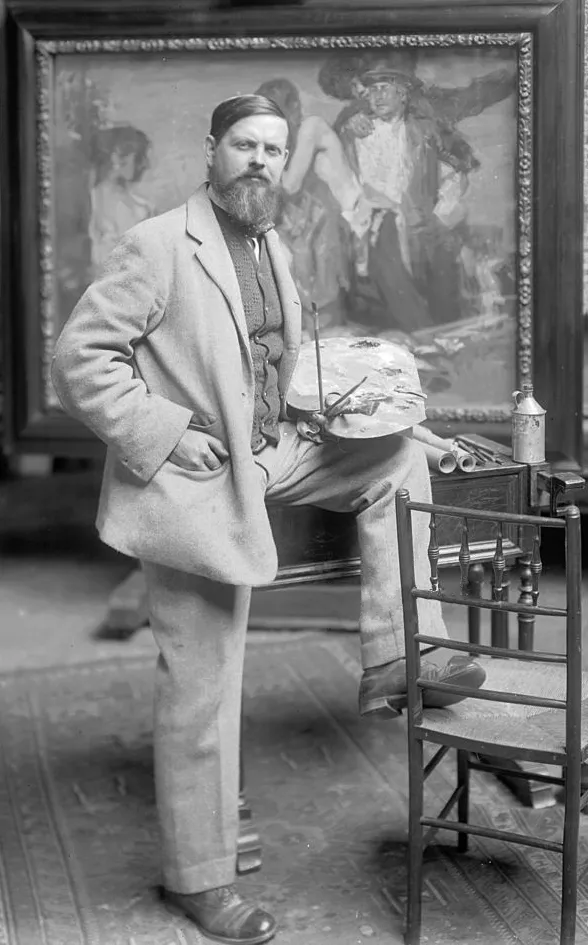
The Lodge was a study in contrasts: the drawing-room was a ‘museum of cabinets’ arranged with ‘meticulous precision,’ while the massive 40-foot square studio was a place of ‘lordly disorder’. This studio, where Brangwyn ‘painted big’ and created his world-renowned mural decorations, eventually became the foundation for the extension that now houses The Gate restaurant.
IV. The Ideal Husband
Brangwyn was described as boyish and unaffected, a man of ‘engaging simplicity’ who loved a joke and was devoted to his wife and his art. He claimed that after an initial period of adjustment to domesticity, he became the ‘ideal husband’ who was always at home. This peaceful tenure lasted until 1914, when the Great War ‘bombed him out of London,’ forcing him to leave his beloved secluded spot.
Adapted from and with quotes from Macer-Wright, Philip (1940). Brangwyn, A study of Genius at Close Quarters. London: Hutchinson & Co.